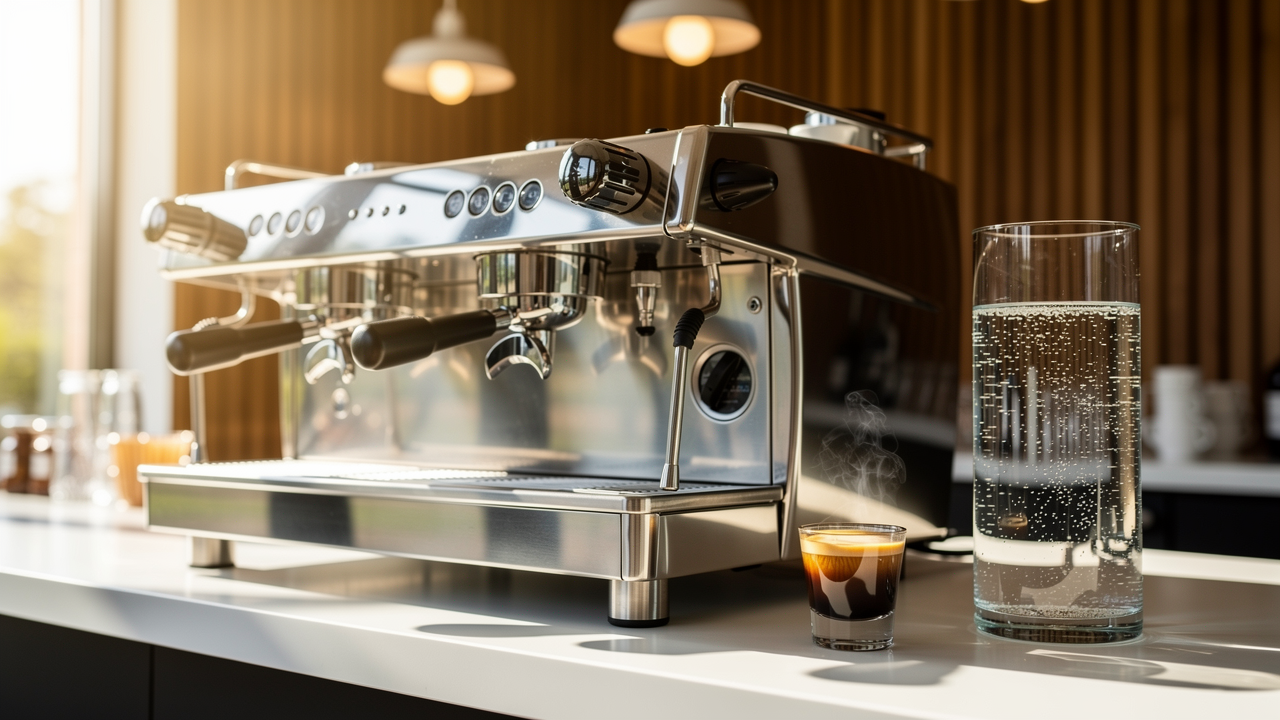

What Parameters Define Professional Coffee Water Treatment and Equipment Protection?
Water Treatment for Professional Coffee Machines: Protecting Equipment and Perfecting Flavor begins with a clear picture of water chemistry. The composition of the water feeding a commercial espresso machine determines how long its boiler survives and how the brewed beverage tastes in the cup. Professional coffee water treatment functions as a mechanical safeguard as much as a flavor tool.
Operators managing water chemistry parameters typically track a handful of figures: total hardness, calcium hardness, total alkalinity, pH, total dissolved solids, and residual disinfectant levels such as chlorine or chloramine. Each value influences a different failure mode, from scale buildup to metal corrosion. The Specialty Coffee Association standard sets target ranges for calcium hardness and total alkalinity intended to keep brewing water chemically balanced without promoting either scale or corrosion.
Minerals play a double role. Calcium and magnesium carry flavor compounds and support extraction, yet the same minerals precipitate into hard deposits once heated repeatedly inside a boiler. Balancing that dual function, rather than removing minerals entirely, is the central task of professional coffee water treatment.
Scale and Corrosion: How Heat Turns Minerals Into Equipment Damage
Inside an espresso boiler, dissolved calcium bicarbonate breaks down under heat and releases carbon dioxide, leaving insoluble calcium carbonate behind as limescale. Boiler scaling narrows internal flow pathways, coats solenoid valves, and skews temperature sensors built to read against a clean metal surface. Heat transfer efficiency drops steadily as scale insulates the heating element from the water it is meant to warm.
The opposite failure occurs in acidic, low-mineral water. Where hardness is low and pH sits below neutral, the same heat that would otherwise deposit scale instead promotes localized corrosion on brass, copper, and stainless steel fittings. The WHO guidelines describe how pH, alkalinity, and dissolved mineral content jointly govern whether water tends toward scale precipitation or metal attack.
Warning signs include longer boiler recovery times between shots, pump pressure that drifts rather than holding steady, and heating elements that fail well before their expected service life. None of these symptoms are cosmetic; each points to a chemistry imbalance already acting on internal components.
Comparing Filtration Technologies for Espresso and Brewing Systems
Particulate pre-filtration combined with activated carbon filtration removes sediment first, then adsorbs chlorine, chloramines, and volatile organic compounds that would otherwise dull aroma and introduce chemical off-flavors into the cup.
Ion exchange softening follows a different mechanism, exchanging calcium and magnesium ions for hydrogen or sodium. Weak-acid cation resin lowers both hardness and alkalinity together, while strong-acid cation resin targets hardness alone and leaves alkalinity largely unchanged. The choice between the two depends on how much alkalinity reduction a given espresso recipe requires.
Scale inhibition offers a lighter-touch alternative. Polyphosphate dosing or template-assisted crystallization media alter the physical structure of calcium carbonate so it stays suspended rather than bonding to hot metal surfaces, without stripping the water of its mineral content.
Reverse osmosis removes nearly all dissolved solids, and bypass blending valves then reintroduce a controlled portion of the original feed water to rebuild a target mineral profile. The EPA secondary standards guidance outlines aesthetic parameters, including TDS and chloride, that influence how much blending a given water supply needs.
Matching Water Treatment Setups to Commercial Coffee Applications
The right configuration depends on daily beverage volume, raw water hardness, and the disinfectant used by the local utility. A café pulling a modest number of shots a day on soft municipal water has different needs than a high-volume operation running several boilers on hard, well-fed supply.
Espresso machine water treatment for high-temperature boilers generally requires precise alkalinity control, since excess alkalinity buffers acids that would otherwise dissolve trace heavy metals from internal components. Commercial batch brewers and filter coffee equipment place more weight on carbon filter capacity and taste clarity, since larger volumes pass through with each brew cycle.
| Treatment Approach | Primary Function | Best Fit |
|---|---|---|
| Activated Carbon and Sediment Prefiltration | Taste and disinfectant removal | Low-hardness municipal supply |
| Ion Exchange Softening | Hardness reduction | Medium-to-high hardness regions |
| Polyphosphate Scale Inhibition | Crystal structure modification | Moderate scale risk, limited footprint |
| Reverse Osmosis with Bypass Blending | Mineral and TDS control | Variable, high-hardness, or high-chloride water |
Testing and Maintenance Schedules That Prevent Costly Failures
Drop titration testing kits measure temporary and total hardness directly, giving a more direct hardness reading than an electrical conductivity meter, which reports overall dissolved solids rather than the calcium and magnesium fractions that actually cause scale.
Filter cartridge replacement should follow metered volumetric throughput, counted in liters processed, rather than a fixed calendar date. A slow café and a high-volume bar exhaust the same cartridge at very different rates, so a flow meter reading is a more reliable trigger than a monthly reminder.
Municipal water utility reports change with reservoir shifts and seasonal treatment adjustments, so hardness and disinfectant figures used to size a system a year earlier may no longer match current supply. Reviewing these reports periodically, alongside logkeeping, visual inspection of heating elements during routine servicing, and pressure differential monitoring across filter housings, keeps preventive maintenance grounded in actual conditions rather than assumptions.
All details are available at the following link: aquaphorpro.com.
Common Water Quality Myths That Damage Coffee Equipment
A low reading on a total dissolved solids meter is often read as proof that water will not scale a boiler. TDS measures everything dissolved in water, not the specific calcium and magnesium fraction responsible for limescale, so a low overall number can still carry enough hardness to damage a heating element over repeated cycles.
Acceptable taste is another unreliable signal. Calcium and magnesium are largely flavor-neutral at the concentrations found in most tap water, so an espresso can taste balanced while scale continues to accumulate inside the boiler, unnoticed until recovery times lengthen or a component fails.
Softened water myths persist around domestic water softeners repurposed for commercial use. Traditional sodium-swap softeners exchange calcium for sodium, removing hardness but leaving alkalinity intact and adding sodium that alters extraction, making them a poor match for espresso-grade requirements.
Mineral-free purified water carries its own scale prevention misapprehensions. Distilled or un-remineralized reverse osmosis output is aggressive toward metal surfaces, since water with almost no dissolved mineral content tends to draw material from surrounding brass and copper fittings, accelerating corrosion while producing flat, under-extracted coffee.
Additional research from neutral laboratory sources would help confirm regional variations in raw water hardness and their effect on filter cartridge lifespan.
What is the ideal calcium hardness for espresso water?
Specialty coffee water standards generally target a moderate calcium hardness range alongside a comparable alkalinity level, keeping enough mineral content for flavor while limiting the load available for scale formation inside heated boilers.
Can a domestic water softener protect a commercial espresso machine?
Domestic sodium-swap softeners remove hardness but leave alkalinity unchanged and add sodium, producing water chemistry that rarely matches the balance professional coffee water treatment requires for consistent extraction and boiler protection.
How often should filter cartridges be replaced?
Replacement should follow metered volumetric throughput rather than a fixed calendar schedule, since actual water usage, not elapsed time, determines when carbon or ion exchange media reaches capacity.
Does reverse osmosis water need remineralization for coffee brewing?
Yes; un-remineralized reverse osmosis output lacks the mineral content needed for extraction and can be aggressive toward metal machine components, which is why commercial systems typically use bypass blending to restore a target mineral profile.
About the Business
AQUAPHOR Professional is an international developer and manufacturer of advanced commercial and industrial water purification systems, engineered for applications across industrial, commercial, agricultural, HoReCa, healthcare, and municipal sectors. The company's commercial water filtration range includes advanced reverse osmosis systems, compact hollow fiber filtration units, and specialized ion exchange media built for demanding water conditions. Its high-efficiency water treatment equipment is produced to global engineering standards, supported by durable manufacturing processes and technical support networks intended to keep equipment running reliably and beverage quality consistent for commercial clients worldwide.

About the author